Work
Supply chain · Silicon · Strategy
Now
Aaj Supply Chain
WMSTMSONDCProcess mapping
Own product definition for WMS 2.0 across Inward, Inventory and Picking — turning an undocumented legacy system into the specification the engineering team builds from.
Went to the floor across all seven warehouses and recorded how people actually work. Six exception paths existed in practice and in no document anywhere.
Architected the ONDC adapter for the TMS — the order state machine, and the thirty edge cases that decide whether it survives real traffic.

Before
Analog Devices

Most electric cars wire every battery pack back to a central controller. We were building the version without the wires: each pack doing its own processing at the edge, talking to a controller in the dashboard over radio.
I owned the power management unit on that chip. The design ran on two CPUs — a low-power one that keeps the battery system alive continuously, and a high-power one that only wakes when the car actually needs it. My part was the state-cycling algorithm across both: when each CPU wakes, which state it drops into, and the conditions that must and must not hold for every transition between them. Six months on it, and still the most interesting problem I’ve been handed. It took about 30% out of the chip’s leakage power.
Alongside that I was design owner for the QSPI, SPI, I2C and UART blocks, led a six-person team verifying the PMU, and built SystemC models so the software team could test features before there was any silicon to test them on.
Interned here in 2021, and came back with an offer.
The chip was a DSP that ends up doing noise cancellation inside cars, in-car voice pickup, and the artificial sound electric vehicles make so pedestrians hear them coming. Its filter accelerator worked through one stage at a time, and I was asked to make it run them in parallel.
I redesigned the compute unit so four multiply-accumulate units stay busy every cycle instead of sitting idle — roughly a 4× improvement in processing time. Modelled it in MATLAB, rebuilt it in Simulink with HDL-compatible blocks so the hardware description generated straight out of the model, and left every surrounding memory block untouched so it could drop into the existing chip.
EY-Parthenon

Two months in Singapore, four projects, and a crash course in how consulting actually runs. The biggest was working out why luxury spending across Southeast Asia had stalled — around 70% of the brands we looked at were facing flat or falling revenue. I wrote the interview guide, sat in on twenty-odd conversations with senior executives, and benchmarked eleven brands across Singapore, China, Japan and France. Singapore came out more than 5% more expensive on the same items, which explained the 10–15% of tourist spending that had quietly moved to Japan and Europe.
The others: a fifteen-week operating-model redesign for an APAC food and beverage group, covering ten functions and landing on a three-tier structure worth about 20% in efficiency; a market-entry roadmap for a German kitchen brand coming into India; and a negotiation framework for retailers staring down 20% mall rent increases. Two months isn’t long enough to become a consultant. It’s long enough to find out you can hold your own in a room full of them.
Product
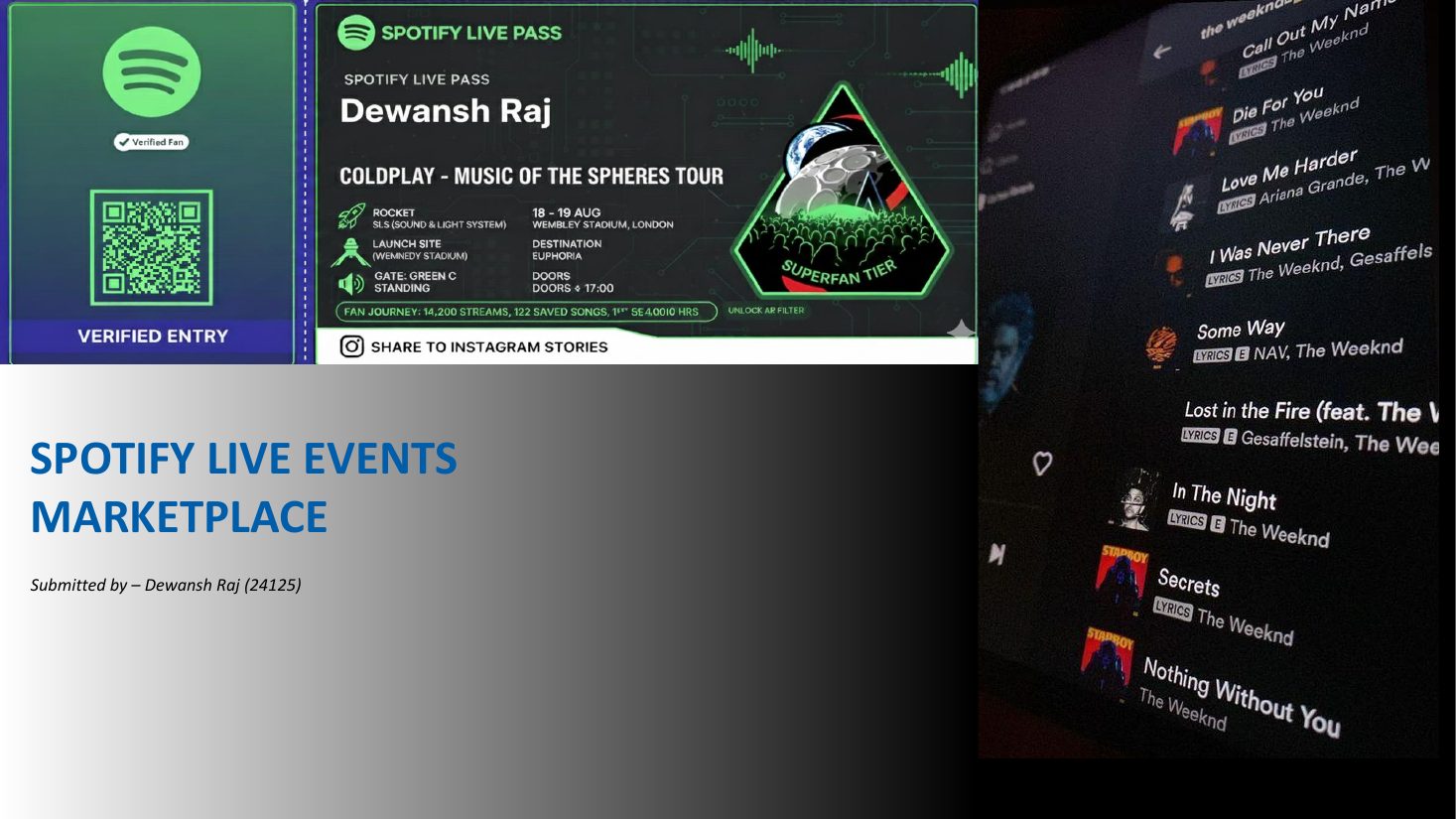
Spotify Live Events Marketplace
A product case for turning Spotify from somewhere you listen into somewhere you buy tickets. 626 million people use it every month and roughly two-thirds of them miss gigs by artists they already follow, while the platforms that do sell the tickets take 25–30% off the top. I mapped the user journeys for fans and for artists, and worked out where the marketplace could sit without wrecking the thing people already like about the app.
PDF ↗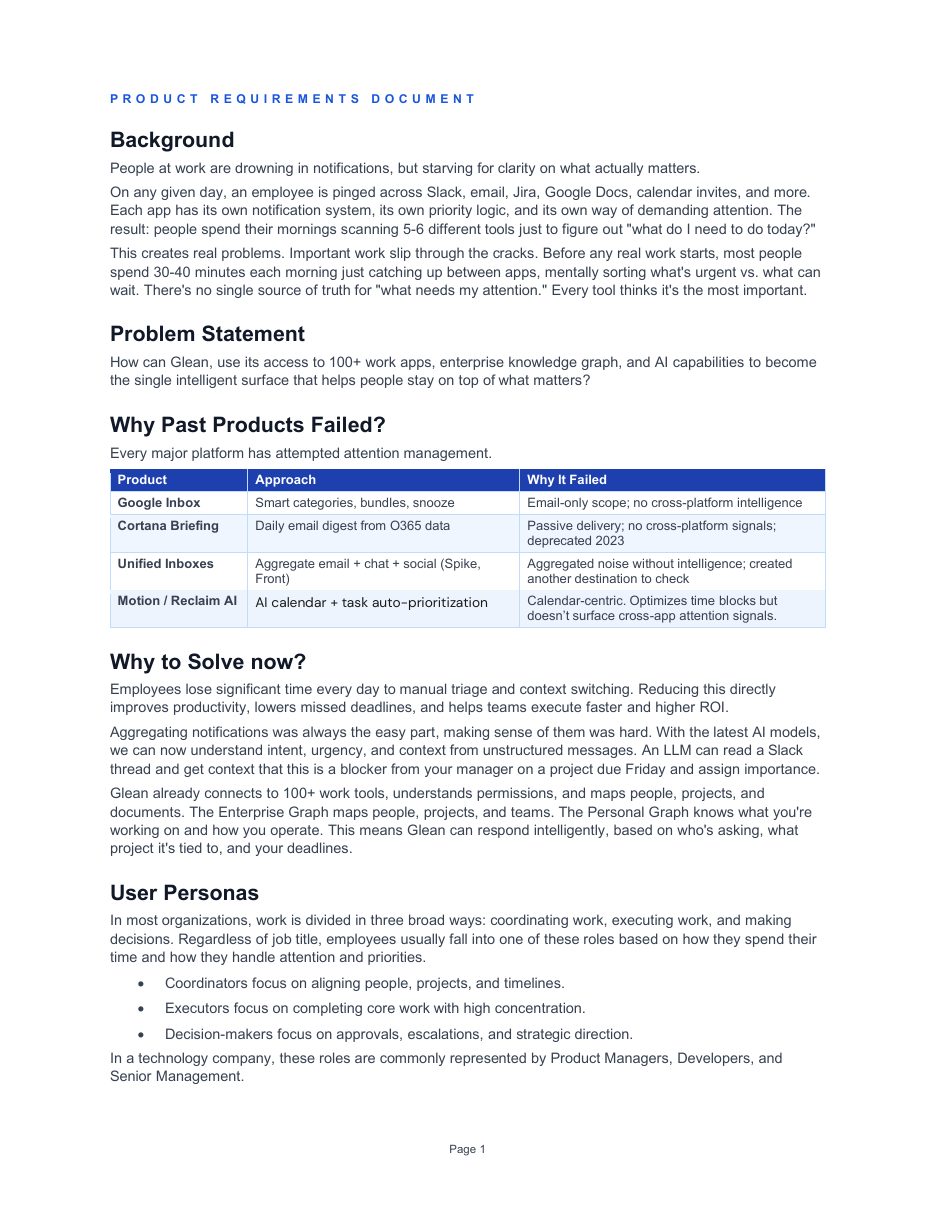
Notification triage PRD
A full requirements document for a product that answers one question: what do I actually need to do today? People at work are drowning in notifications across Slack, email, Jira, calendar and docs, each with its own idea of what’s urgent, and most spend the first half hour of the day just reconciling them. Problem, users, scope, success metrics, and the things I deliberately left out.
PDF ↗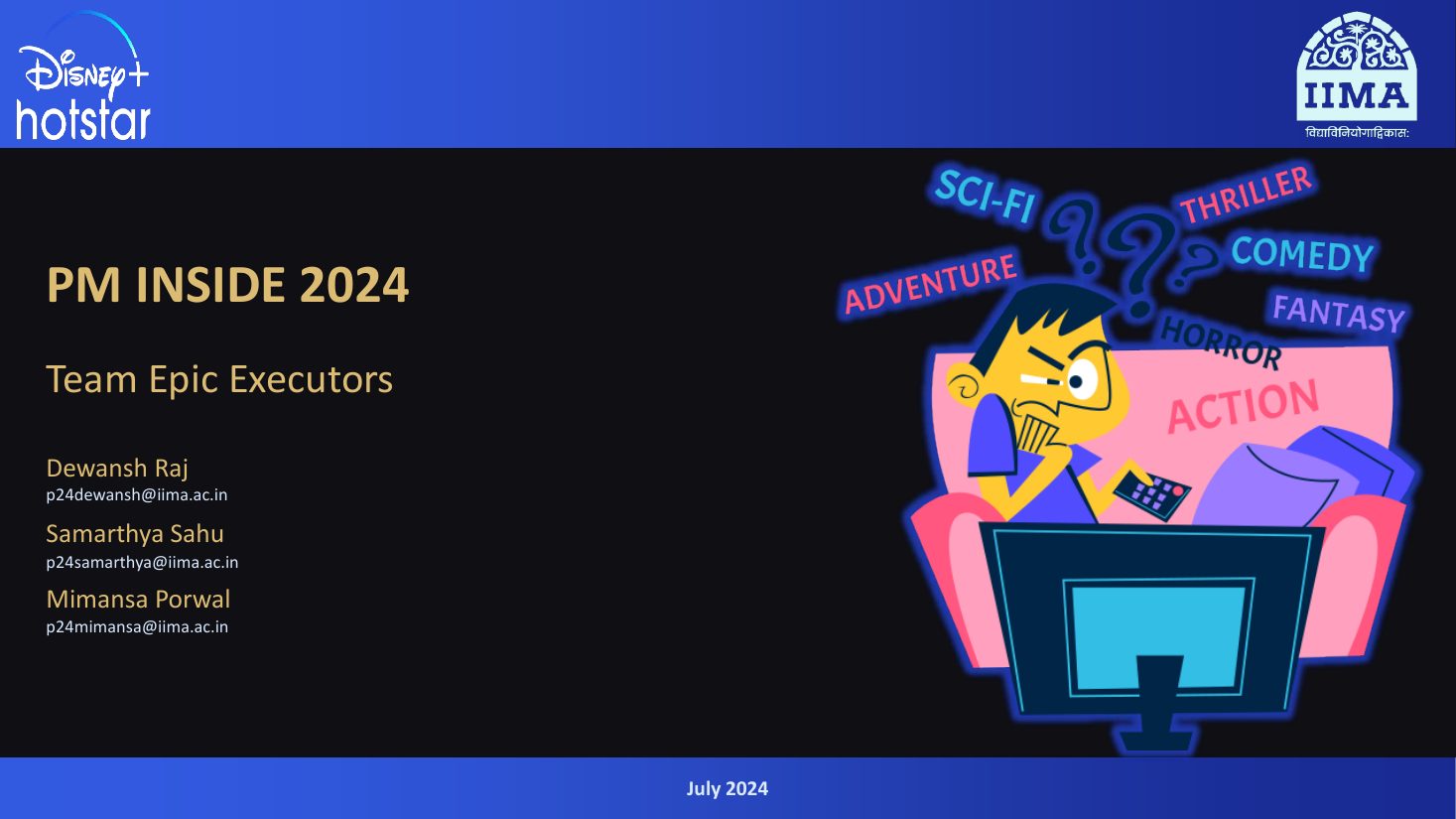
PM Inside 2024
Top 8 of 94 teams at PM Inside, run by the ProdMan Club at IIM Ahmedabad. We took apart Disney+ Hotstar — its subscription tiers, where regional content and sport actually carry the platform, and what it’s up against from Netflix and Prime. Three of us, one weekend, and a lot of arguing about pricing.
PDF ↗Built
StoryForge AI
An AI-powered platform for writing and managing stories — characters, plot threads, and the state of a world you’re building, held together so the model stays consistent instead of forgetting what it wrote three chapters ago. Built because I wanted it to exist.
Repo ↗Real-time aggression detection
Software that listens to a conversation between two people and works out when it’s turning hostile — who is speaking, when they talk over each other, and what the tone is doing. Trained on recorded interviews and running live on an Android phone. The obvious homes for it are call-centre monitoring and negotiation coaching. My bachelor’s thesis at IIT Kharagpur.
Slides ↗Faster power delivery under load
When a processor suddenly demands more current, the supply feeding it sags and everything downstream stutters. I designed a second, faster path that reacts to the spike before the main control loop can — about two-thirds less voltage dip and roughly half the settling time. It’s the difference between a laptop that stutters when it’s working hard and one that doesn’t. My master’s thesis.
Thesis ↗RoboCup Small-Size League
Kharagpur’s robot football team, and the only Indian side to qualify for the Small-Size League. I led it — ten-plus people, a ten-lakh budget, vendors who didn’t take us seriously, and a kicking mechanism that took three prototypes before it stopped failing. This is the paper we submitted to qualify.
Team paper ↗